An In-Depth Analysis of CES Tokenomics, Vesting, Holder Distribution, Ecosystem Growth, and Price Potential from 2026 to 2030
Introduction
The CES token has attracted increasing attention within the V-Boost ecosystem. While many investors focus only on short-term price movements, understanding a project’s tokenomics, vesting schedule, holder distribution, and ecosystem expansion often provides a much clearer picture of its long-term potential.
This analysis combines historical observations, on-chain statistics, platform metrics, and future roadmap developments to estimate where CES could be heading between 2026 and 2030.
Disclaimer
This article reflects my personal understanding, observations, and research based on publicly available information and official materials.
It is intended solely for educational purposes and should not be interpreted as financial, investment, legal, or professional advice.
Readers are encouraged to conduct independent research and verify information through official sources before participating in any ecosystem.
Current CES Statistics
At the time of writing:
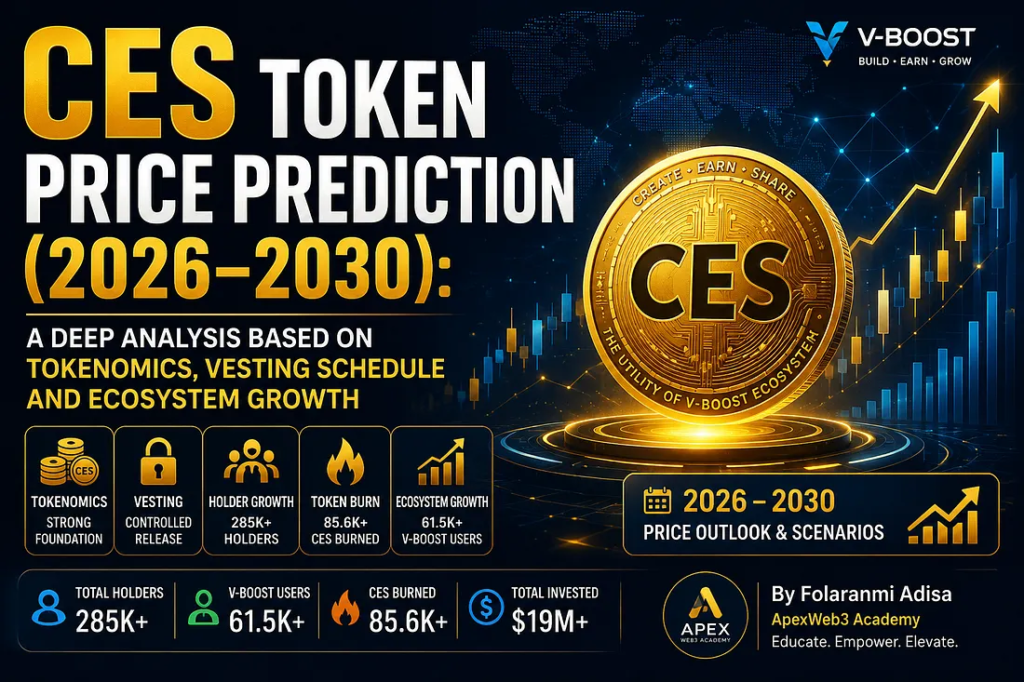
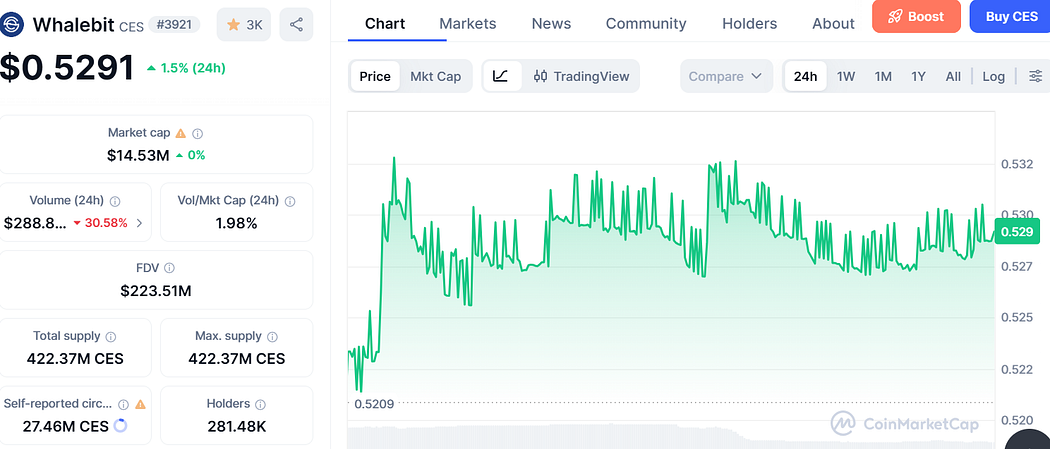
- Total Supply: 422.37 million CES
- Self-Reported Circulating Supply: 27.46 million CES (6.5%)
- Fully Diluted Market Cap: Approximately $203 million
- Total Holders: More than 285,000 wallets
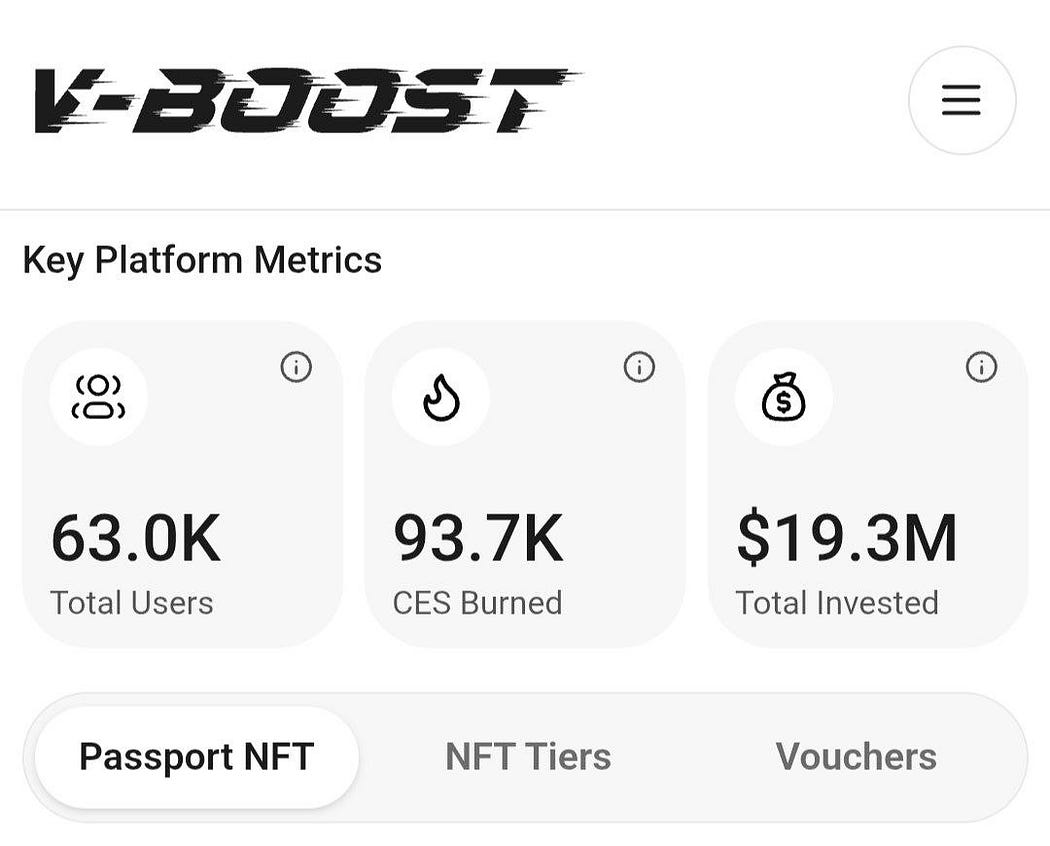
- V-Boost Users: Over 61,500
- CES Burned: More than 85,600 CES
- Total Investment into V-Boost: Over $19 million
These numbers indicate that only a small percentage of the total supply is actively circulating, while most tokens remain under controlled release schedules.
Understanding CES Token Distribution
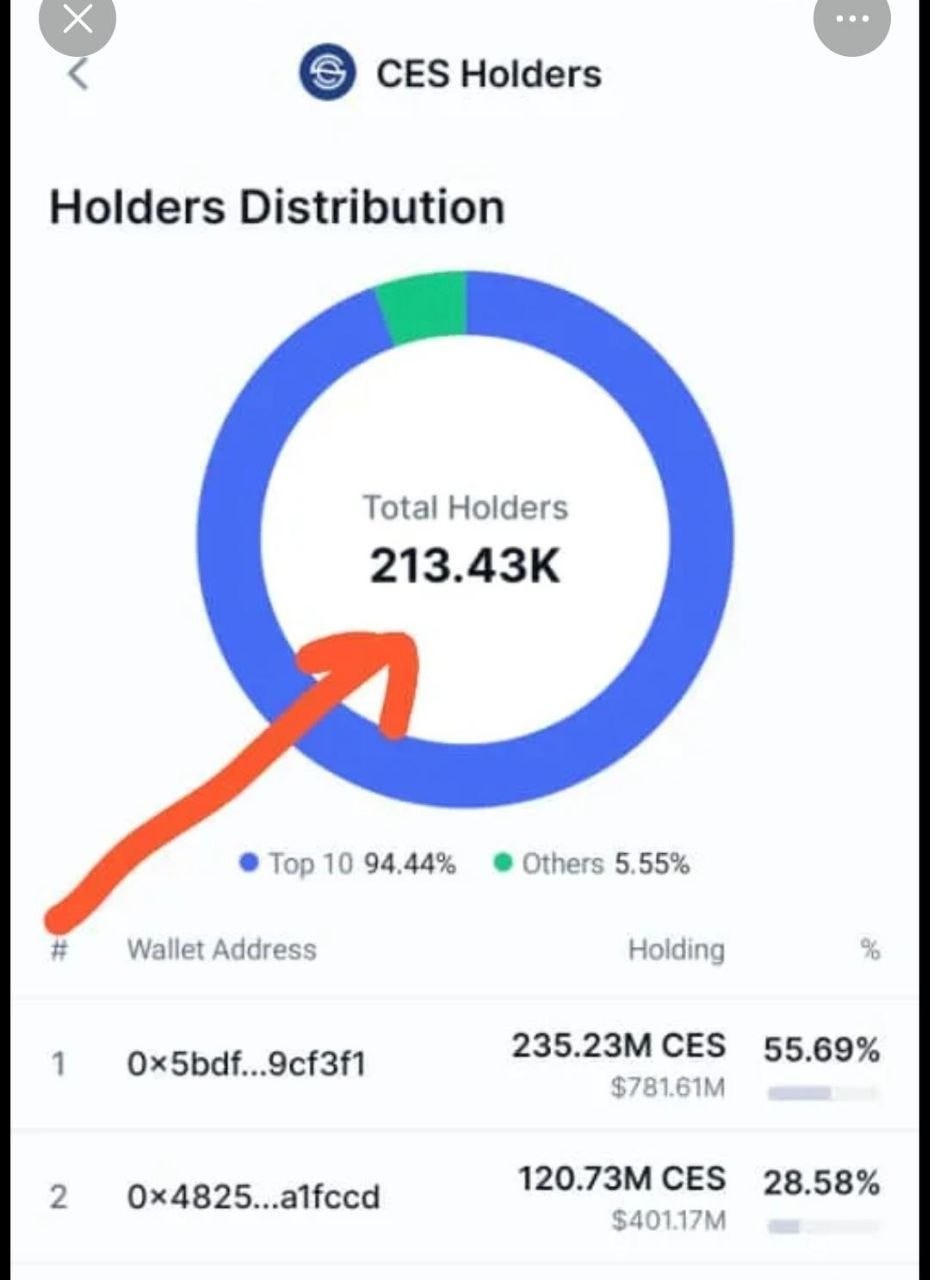
One of the biggest concerns investors usually have is the concentration of tokens in the top wallets.
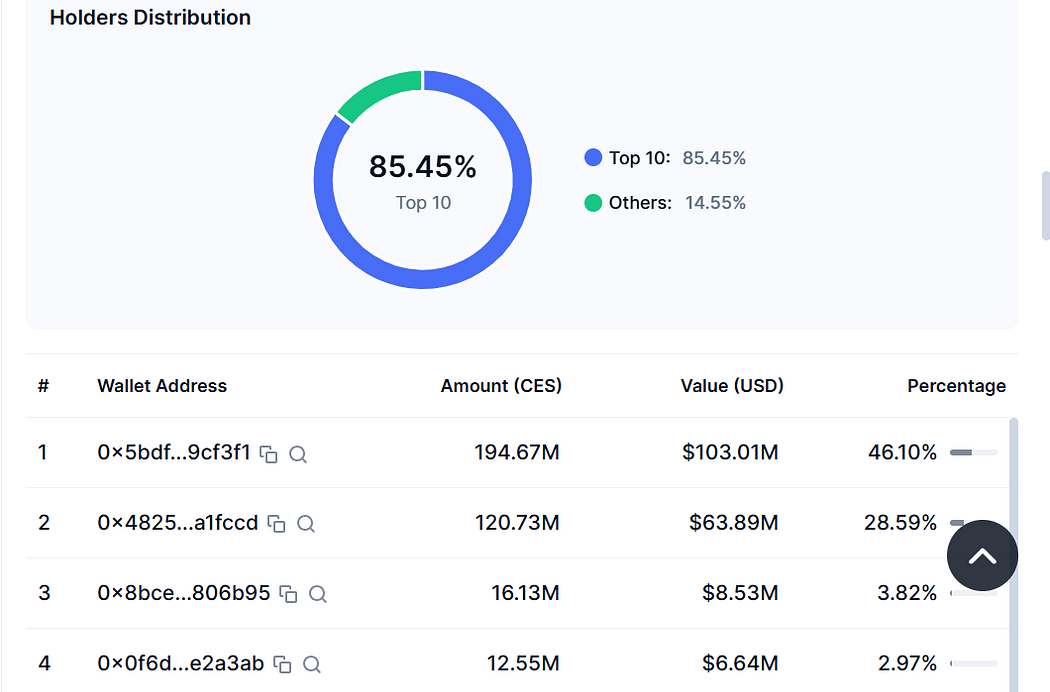
At first glance, the top two wallets appear to own approximately 75% of the total supply.
However, this requires proper context.
These wallets are not typical whale investors.
Instead, they are official vesting wallets responsible for releasing community tokens gradually according to predetermined schedules.
This means these wallets are designed to distribute tokens — not dump them onto the market.
Vesting Timeline
CES follows a structured release mechanism.
Community Vesting
Investors who participated during the 2023 presale selected vesting periods ranging from 1 year to 5 years.
These vested tokens are released daily.
Expected completion:
2028–2029
Holding Release Program
A second controlled release mechanism was introduced to reduce immediate selling pressure after launch.
This release schedule is expected to finish around:
February 2027
This means one major source of token inflation should largely disappear after early 2027.
Why This Matters
Every cryptocurrency faces supply pressure.
The key question is:
Will demand grow faster than supply?
For CES, demand could potentially increase from several factors:
- Growth of the V-Boost platform
- More Passport NFT users
- Increasing CES burning
- New ecosystem products
- Exchange listings
- Reduced token releases after 2027
If demand outpaces new token supply, upward price pressure becomes more likely.
Holder Growth
Historical data shows holder growth from approximately:
213,000 holders → over 285,000 holders
This represents an increase of more than 70,000 wallets.
Growing holder count generally indicates expanding community participation, although it does not guarantee price appreciation.
Ecosystem Growth
The V-Boost ecosystem continues expanding through:
- Passport NFTs
- Tier upgrades
- CES utility
- Token burn mechanisms
- Growing investment volume
- Planned Guru.fun platform
- Potential centralized exchange listings such as Bybit and OKX
If these milestones are successfully delivered, they could improve visibility and liquidity for CES.
Supply Dynamics
The market currently experiences selling pressure from ongoing vesting releases.
However, this pressure should gradually reduce as:
- Holding releases finish in February 2027
- Vesting schedules approach completion during 2028–2029
Historically, many cryptocurrencies have experienced stronger price performance after major vesting periods conclude because fewer new tokens enter circulation.
Possible Price Scenarios
Conservative Scenario
If ecosystem growth remains steady but adoption is moderate:
- End of 2026: $0.70–$1.20
- End of 2027: $1.20–$2.00
- End of 2028: $2.00–$3.50
- End of 2029: $3.00–$5.00
- End of 2030: $4.00–$7.00
Base Scenario
Assuming successful roadmap execution, continued user growth, and major exchange listings:
- End of 2026: $1.00–$1.80
- End of 2027: $2.00–$4.00
- End of 2028: $4.00–$7.00
- End of 2029: $6.00–$10.00
- End of 2030: $8.00–$15.00
Bullish Scenario
If V-Boost achieves large-scale adoption, Guru.fun becomes successful, CES is listed on major exchanges, and the broader crypto market enters a strong bull cycle:
- End of 2026: $1.50–$2.50
- End of 2027: $4.00–$7.00
- End of 2028: $8.00–$12.00
- End of 2029: $12.00–$20.00
- End of 2030: $20.00–$35.00
These projections assume favorable market conditions and successful execution of the roadmap. They are not guaranteed outcomes.
Risks Investors Should Watch
Despite the positive outlook, several risks remain:
- Delays in roadmap delivery
- Slower-than-expected user growth
- Continued selling from vested token recipients
- Overall cryptocurrency market downturns
- Regulatory changes affecting digital assets
- Delayed exchange listings
Investors should monitor these factors closely.
Final Thoughts
CES is still in the early stages of its token distribution journey. While ongoing vesting creates short-term selling pressure, the structured release schedule also provides transparency.
As holding releases conclude in early 2027 and community vesting gradually winds down by 2028–2029, supply pressure is expected to decrease.
If the V-Boost ecosystem continues expanding through user adoption, CES burns, Passport NFTs, Guru.fun, and major exchange listings, the token could be well positioned for long-term growth.
For long-term investors, the most important metrics to monitor are not daily price fluctuations but ecosystem adoption, active users, circulating supply growth, token burns, and roadmap execution.
The coming years will determine whether CES evolves into one of the stronger utility tokens within its ecosystem.
About the Author
I am the founder of ApexWeb3 Academy and a passionate blockchain educator who enjoys helping beginners understand Web3, NFTs, blockchain technology, and digital assets in simple language.
Over the years, I have learned that education and understanding should always come before excitement.
Through ApexWeb3 Academy, I enjoy documenting my journey and sharing what I learn as I continue exploring blockchain technology and emerging ecosystems.
Connect With Me
I enjoy documenting my learning journey and sharing educational content about Web3, blockchain technology, and digital ownership.
🔹 YouTube
🔹 Telegram
Thank you for reading.
Continue Your Learning Journey
Thank you for taking the time to read this article.
If, after doing your own research and studying the ecosystem, you decide that you would like to explore V-Boost further, you are welcome to use my referral link below:
🔗 https://app.v-boost.top/sso/signin?ref=1290
I enjoy helping beginners understand Web3 and the Vistory ecosystem, so feel free to connect with me if you have questions or would like guidance during your learning journey.
As always, understanding comes before excitement.
📚 Related Articles
🔹 V-Boost Ecosystem Explained (2026): Complete Guide to CES Token, Passport NFTs, Vistory Games, Tiers, and Subscription System https://medium.com/@folaranmiadisa/v-boost-ecosystem-explained-2026-complete-guide-to-ces-token-passport-nfts-vistory-game-tiers-6d3a31a76378
🔹 How I Learned to Join V-Boost: A Beginner’s Guide to Getting Started in the Vistory Ecosystem https://medium.com/@folaranmiadisa/how-i-learned-to-join-v-boost-a-beginners-guide-to-getting-started-in-the-vistory-ecosystem-200c0b9a8f7a
🔹 What Is Passport NFT and Why Is It Important in V-Boost? https://www.linkedin.com/pulse/what-passport-nft-why-important-v-boost-folaranmi-adisa-9kpbf
🔹 Five Mistakes I Think Beginners Should Avoid in V-Boost https://www.linkedin.com/pulse/five-mistakes-i-think-beginners-should-avoid-v-boost-adisa-folaranmi-gayuf
🔹 VGF, CES, BGB, Tiers, Subscriptions, Passport NFT, and Vistory Games: Understanding the Core Components of V-Boost https://www.linkedin.com/pulse/vgf-ces-bgb-understanding-three-important-components-inside-adisa-n3ggf
🔹 Why I Stopped Ignoring V-Boost: My Journey from Curiosity to Understanding https://www.linkedin.com/pulse/why-i-stopped-ignoring-v-boost-my-journey-from-adisa-folaranmi-xfpnf
🔹 What Is V-Boost and How Does It Work? A Complete Beginner’s Guide to the Vistory Ecosystem https://paragraph.com/@apexweb3academy/what-is-v-boost-and-how-does-it-work-a-complete-beginners-guide-to-the-vistory-ecosystem?referrer=0x706d6e8D853C46326F04A19C6C23641625Ca80b7
✍️ By Folaranmi Adisa
Founder, ApexWeb3 Academy
Blockchain Educator | Web3 Enthusiast | Documenting My Learning Journey Through the Vistory Ecosystem